

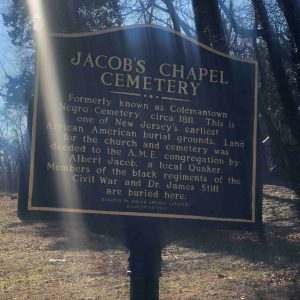
The church was built in 1859 by the Black congregants of the Colemantown Meeting House. Colemantown Meeting House was erected in 1813 and served as a school, a place of worship and an Underground Railroad stop. Colemantown Meeting House is named after John Coleman, who was an early preacher there and a conductor on the Underground Railroad.

The first Jacob’s chapel that the congregants built was originally located elsewhere but it now currently resides next to Colemantown House- on the original land that was donated back in 1813.

That land was donated from a Quaker named Albert Jacob, hence the name Jacob’s Chapel, for the purpose of a school and place of worship. Jacob is said to have been a Quaker (the church is right next to a Quaker church), however, no records can be found of Albert Jacob, which is considered unusual since Quakers are known for keeping good records. Notable burials there include James Still – the Black Doctor of the Pines. He was born in 1812 and died in 1882. He was one of the founders of the church and is a historic South Jersey/ Mt. Laurel figure. He was born to former slaves from Maryland who settled in New Jersey. His father bought his own freedom, but his mother escaped. Upon escaping to New Jersey, they changed their name to Still to blend in with the Black Stills already in New Jersey to avoid detection from slave catchers.

James Still was a self-taught herbalist and doctor who helped cure the locals of various ailments. He developed a cough balm that proved to be successful in healing patients, even pharmacists in Philadelphia purchased it, which earned him the honorary title of Doctor. His brother, William Still, known as the Father of the Underground Railroad, is also buried there.

